
Energy Storage, Solar Inverters & EV Charging: The Technology Decision-Maker’s Guide for African C&I Operations
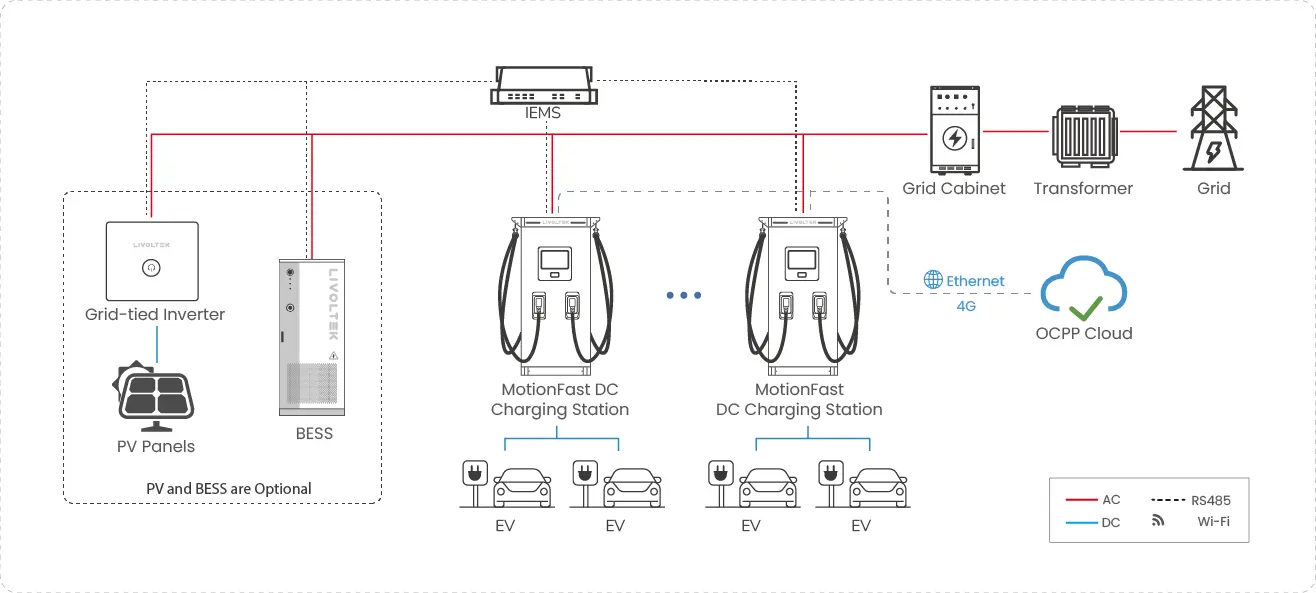
Behind every successful commercial solar installation in Africa lie three critical technology decisions: which inverter architecture converts your power most efficiently, which energy storage system protects your operations most reliably, and how you future-proof your facility for the electric mobility revolution. This guide gives industrial, utility, and commercial decision-makers the technical depth needed to evaluate, compare, and specify the core hardware that determines the success of any C&I solar investment.
Why This Matters: Your inverter, battery, and charging infrastructure choices determine system efficiency, reliability, and expandability for the next 15–25 years. A 1% difference in inverter conversion efficiency on a 500 kWp system can mean R50,000+ in additional revenue over its lifetime.
Part A: Commercial & Industrial Solar Inverters
1. Understanding C&I Solar Inverter Technology
A commercial solar inverter in Africa must do far more than simple DC-to-AC conversion. Modern C&I solar inverters integrate maximum power point tracking (MPPT), anti-islanding protection, power quality management, and communication interfaces. The three-phase solar inverter is the standard for commercial and industrial applications in Africa. View the full Livoltek solar inverter range to explore specifications for African grid conditions.
Inverter Architectures for C&I Applications
String inverter technology dominates the C&I space, with commercial string inverters offering power ratings from 10 kW to 350 kW. A three-phase string inverter provides excellent efficiency and reliability while enabling flexible system design with multiple MPPT inputs. The number of MPPT channels—such as solar inverters with 10 MPPT inputs—determines how effectively the inverter handles panels at different orientations, tilts, or shading conditions.
The market offers options across every power class: 10 kW solar inverters for small commercial, 30 kW hybrid inverters for medium businesses, 50 kW and 60 kW commercial solar inverters, 75 kW solar inverters, 100 kW and 125 kW solar inverters in South Africa for large C&I, 150 kW commercial inverters, and 200 kW solar inverters in Africa for major industrial facilities. Central inverters in South Africa remain relevant for very large utility-scale installations. Dual MPPT solar inverters serve smaller commercial applications requiring flexibility.
Grid-Tied vs Hybrid Inverters
A grid-tied inverter in South Africa connects directly to the utility grid and exports excess power according to the facility’s net metering or feed-in arrangement. On-grid solar inverters in Africa are the simplest and most cost-effective option for facilities with reliable grid access. Single-phase grid-tied inverters serve smaller commercial applications, while three-phase models handle larger loads.
A hybrid inverter for commercial applications integrates battery storage management, enabling solar-plus-storage configurations without a separate battery inverter. The commercial hybrid inverter can operate in grid-tied mode during normal conditions and seamlessly transition to backup mode during outages—a critical capability for businesses needing a load shedding solution. Grid-forming inverter technology in Africa is advancing rapidly, enabling inverters to create and maintain a stable microgrid independently of the utility grid.
Advanced Inverter Features
Modern smart PV controllers incorporate a range of protective and performance-enhancing features. AFCI (Arc Fault Circuit Interrupter) protection reduces fire risk from damaged DC wiring. PID (Potential Induced Degradation) recovery reverses efficiency losses in solar panels over time. Night SVG capability allows inverters to provide reactive power compensation even when the sun isn’t shining. SPD integration, IP65 rating for outdoor installations, and WiFi monitoring connectivity with a solar inverter monitoring app are now standard features on quality commercial inverters. Solar inverter efficiency ratings should be compared using European Weighted Efficiency for accurate real-world performance assessment.
2. Head-to-Head Brand Comparison: Livoltek vs Sungrow, Huawei, Growatt & Deye
When comparing Sungrow vs Huawei solar inverter in Africa, or Growatt vs Sungrow commercial inverter, the differences often come down to local support quality, monitoring platform sophistication, and integration flexibility. The best commercial solar inverter for 2025 and 2026 depends on your specific application—whether it’s a warehouse, factory, mining operation, poultry farm, dairy farm, petrol station, hospital, or agriculture facility. The best solar inverter for business in South Africa and the best solar inverter for factory applications in South Africa will be determined by load profile, grid conditions, and expansion plans.
Sector-Specific Inverter Selection
Different commercial environments demand different inverter capabilities. A solar inverter for mining must withstand harsh conditions and integrate with variable heavy loads. A solar inverter for agriculture needs flexibility for seasonal demand patterns. Solar inverters for warehouses and solar inverters for factories prioritise high self-consumption ratios and seamless integration with existing electrical infrastructure. Solar inverters for office buildings, retail centres, and shopping malls typically require lower power ratings but sophisticated energy management features. An IEC 62109 compliant inverter in South Africa and NRS 097 compliant inverter ensure regulatory compliance across all applications.
Part B: Battery Energy Storage Systems (BESS) for C&I Operations
3. Why Energy Storage Is Critical for African Business
The case for commercial energy storage in Africa rests on reliability, economics, and strategic value. BESS in South Africa addresses the nation’s most pressing business challenge—load shedding. Explore Livoltek’s energy storage systems including the BES-P 125kW/261kWh industrial BESS and review the technical datasheet for detailed specifications.
Industrial energy storage in South Africa enables businesses to implement peak shaving with battery storage, dramatically reducing demand charges that can represent 40–60% of a commercial electricity bill. Energy storage for load shedding ensures uninterrupted operations. A backup power solution in South Africa built around battery technology delivers cleaner, quieter, and cheaper resilience than diesel generators. The load shedding battery backup has become essential infrastructure, providing uninterrupted power supply through solar.
The Economics of Battery Backup for Business
Battery backup for business in South Africa delivers multiple value streams: load shedding protection, peak demand reduction, time-of-use tariff optimisation, and energy arbitrage with battery storage. The battery energy storage cost per kWh in Africa has fallen by over 80% in the past decade, making C&I battery storage systems in South Africa compelling even without the reliability benefits. A solar battery for business in South Africa, when paired with rooftop solar as a solar-plus-storage solution or PV-plus-ESS solution in Africa, maximises self-consumption and minimises grid dependence. This solar storage hybrid system approach delivers the lowest possible LCOE.
4. Energy Storage Technology Deep Dive
The dominant technology for C&I energy storage is lithium iron phosphate (LiFePO4). LiFePO4 battery storage in Africa offers superior safety, longevity, and thermal stability—critical advantages in African environments. Lithium battery storage for commercial applications benefits from the inherent safety of LiFePO4 chemistry, which is highly resistant to thermal runaway. This makes it the preferred choice for battery storage for hospitals, battery storage for data centres, and energy storage for commercial buildings where safety is paramount.
Key specifications to evaluate include round-trip efficiency (battery storage round-trip efficiency of 95–97% for quality systems), cycle life (3,000–6,000+ for LiFePO4), depth of discharge, operating temperature range, and the battery management system (BMS) sophistication. The BMS manages cell balancing, thermal protection, solar battery state of charge monitoring, and inverter communication. Look for a 10-year battery warranty in South Africa from a reputable manufacturer.
System Architectures and Configurations
High voltage battery storage systems operate at 400V or above, offering reduced cabling losses for larger installations. Modular battery storage systems allow businesses to start small and expand—a scalable battery storage approach that aligns capex with demand. Rack-mounted battery storage provides compact, organised indoor solutions. 200 kWh and 300 kWh battery storage configurations serve mid-range C&I applications.
For larger deployments, containerised energy storage delivers a turnkey pre-assembled solution. Utility-scale battery storage in Africa is being deployed at hundreds of MWh, while BTM energy storage in Africa typically ranges from 50 kWh to several MWh. Expandable energy storage system designs ensure long-term flexibility. Grid-forming energy storage enables independent microgrid operation. Smart energy storage management systems enable battery storage for peak demand management, energy storage for load management, and energy storage for demand response.
Thermal Management and Safety
Liquid-cooled battery storage offers superior thermal uniformity for large-scale deployments in hot climates. Air-cooled battery storage in Africa provides a simpler option for moderate climates. Battery storage safety certification in Africa is paramount—look for IEC 62619 and UN38.3 certifications. Battery storage warranty coverage in South Africa should guarantee minimum cycle counts and capacity retention.
Industry-Specific BESS Applications
Energy storage for factories provides critical protection against production disruptions. Energy storage for mining operations must deliver high power output in harsh conditions. Energy storage for telecommunications ensures 24/7 connectivity at remote cell sites, replacing diesel. Battery storage for hospitals provides ultra-reliable backup. Battery storage for data centres requires seamless switchover. Commercial battery backup systems, energy storage for self-consumption, and UPS solar systems in Africa address diverse operational requirements across every commercial sector.
Pricing and Market Trends
Battery storage pricing in South Africa and energy storage system pricing across Africa have become increasingly competitive. Energy storage installation options in Africa should be evaluated on total cost of ownership, not just upfront price. Energy storage in South Africa for 2026 is expected to see further price reductions. Key battery storage trends in Africa include continued cost reduction, growing containerised adoption, and emerging applications in frequency regulation with battery storage for frequency regulation. Battery storage for hospitals, energy storage for demand response, and time-of-use tariff battery storage applications are all expanding.
Buyer’s Tip: When comparing suppliers, insist on independently verified round-trip efficiency data, real-world cycle count validation, and references from operational installations in similar climate conditions. Download the solar battery datasheet and energy storage datasheet from each manufacturer for proper technical comparison.
Part C: EV Charging Infrastructure for Commercial Properties
5. The Business Case for Solar-Powered EV Charging
Electric vehicle adoption across Africa is accelerating, and businesses that install EV charging infrastructure now position themselves for significant competitive advantage. A solar-powered EV charging station combines clean energy generation with mobility infrastructure—a powerful combination for commercial properties. Explore Livoltek’s EV charging solutions and the integrated solar-powered EV charging solution.
The EV charging station market in South Africa is growing rapidly as fleet operators, commercial property owners, and facility managers recognise the opportunity. Commercial EV charging solutions in Africa span from simple AC chargers to high-power DC fast charging infrastructure. EV charging for commercial properties, workplace EV charging in South Africa, and fleet EV charging solutions each address distinct market needs.
EV Charger Types and Specifications
AC EV chargers in South Africa are available in 7 kW (single-phase) and 22 kW (three-phase) configurations, ideal for workplace and destination charging where vehicles park for extended periods. The electric vehicle charger 7 kW is the entry-level option for residential complexes and small commercial sites, while the electric vehicle charger 22 kW serves higher-throughput commercial locations.
DC fast chargers in South Africa deliver rapid charging at 40 kW, 80 kW, 160 kW, and beyond. Ultra-fast EV charging in South Africa is increasingly demanded by fleet operators and highway corridor deployments. The EV charging station cost in South Africa varies significantly based on power rating, number of connectors, and civil works requirements. EV charger installation in South Africa should be performed by qualified electrical contractors familiar with local regulations.
Solar-Integrated EV Charging
The solar storage charging integrated solution—combining PV generation, battery storage, and EV charging (PV-ES-charger solution)—represents the most cost-effective and sustainable approach to EV charging infrastructure in Africa. Solar-powered EV charging infrastructure eliminates the grid capacity constraints that often limit charger deployment. EV charging stations powered by solar in Africa can operate partially or fully off-grid, reducing both energy costs and carbon emissions.
Fleet EV charging solutions increasingly demand smart EV charging management and EV charging load management to optimise power distribution across multiple charging points without exceeding site capacity. Vehicle-to-grid (V2G) technology in Africa, while still emerging, promises to unlock additional value by enabling EVs to feed stored energy back into the building or grid. Bidirectional EV charger technology supports this capability.
Sector Applications
EV charging for shopping centres in South Africa attracts premium tenants and customers. EV charging for office parks serves the growing number of EV-driving professionals. EV charging for hotels in South Africa differentiates hospitality offerings. EV charging for logistics companies and EV charging station for fleet operations supports the transition to electric transport. EV charging for residential complexes in South Africa addresses the needs of multi-unit developments. Electric bus charging in Africa serves public transport operators. EV charger suppliers in South Africa offer a range of hardware options; an EV charging network in South Africa is essential for broader EV adoption.
Emerging business models include EV charging as a service (EVCaaS) in Africa and charging as a service, allowing property owners to deploy infrastructure with minimal upfront investment. The solar EV charging station ROI is increasingly attractive as utilisation rates grow. Green mobility in South Africa is accelerating, creating demand for comprehensive electric vehicle charging infrastructure across Africa.
6. Solar vs Diesel: The Definitive Cost Comparison
For many African businesses, the real comparison is not solar versus grid, but commercial solar versus generator cost. The solar vs diesel generator comparison in Africa reveals dramatic long-term savings. While a diesel generator might cost R5–R8 per kWh of energy delivered (including fuel, maintenance, and depreciation), a solar-plus-BESS system delivers energy at R1.20–R2.50 per kWh. Over a 20-year horizon, the cumulative cost difference is substantial.
An energy storage comparison in South Africa should consider not just battery specifications but total system cost, integration complexity, warranty terms, and local support availability. The best solar battery for business in South Africa and the best solar inverter for business in South Africa are those backed by a manufacturer with local presence, proven installations, and responsive after-sales support across the SADC region.
For a personalised financial analysis comparing your current energy costs against solar-plus-storage, request a free proposal from Livoltek Africa. Our engineering team will model your specific load profile, tariff structure, and operational requirements to deliver a detailed ROI projection.
Related Reading from Livoltek Africa
Livoltek Energy Storage Systems
BES-P 125kW/261kWh Industrial BESS
BUSH Dual-Socket Business AC EV Charger
125kW/261kWh BESS Technical Datasheet
Commercial Rooftop Solar Solutions
Industrial Energy Storage Solutions
Solar-Powered EV Charging Solutions
Industrial Solar ROI Calculator
Electricity Tariff Increases in South Africa
Sources & Further Reading
SAPVIA — SA Photovoltaic Industry Association — South African solar industry body
uYilo — SA eMobility Programme — National electric mobility programme
SADC — Southern African Development Community — Regional development community
BloombergNEF — Energy Storage Outlook — Global storage market data
IRENA — Battery Storage for Renewables — International best practices
GreenCape — Energy Services Market Intelligence — South African green economy data